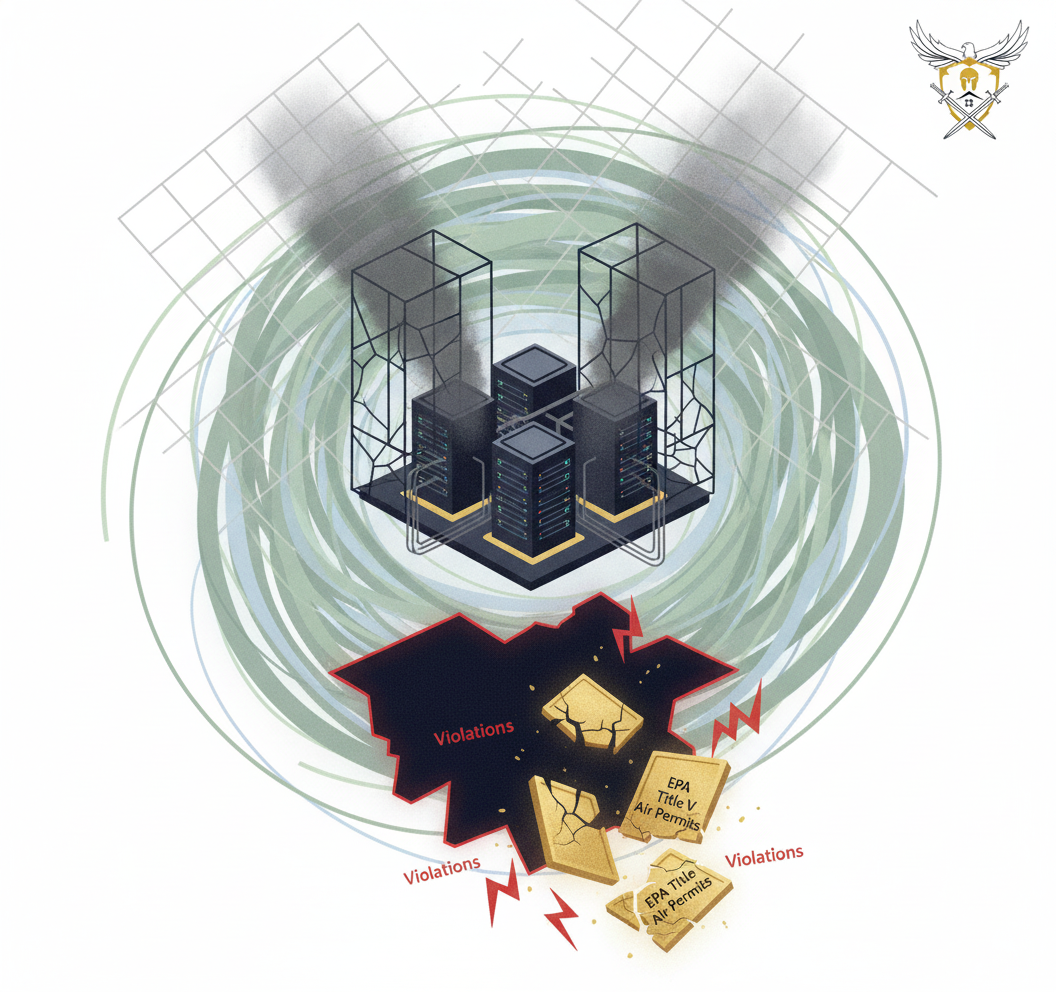
EPA Title V Air Permit Compliance for Hyperscale AI Data Centers: Audit & Risk Framework
Navigate EPA Title V air permit compliance for hyperscale AI data center backup generators and off-grid power to prevent costly regulatory shutdowns.
Are your emergency generator banks one unexpected grid dip away from triggering an immediate EPA shutdown? As hyperscale AI training clusters demand hundreds of megawatts of instantaneous power, environmental compliance directors face an unprecedented regulatory crisis. Operating off-grid natural gas turbines or massive diesel generator fleets to hedge against utility grid delays can instantly push a data center facility into Title V major source status today. If your team lacks an active framework mapping real-time cluster power surges to air permit liabilities, your multi-billion-dollar infrastructure is sitting on a regulatory landmine.
In our experience auditing high-density compute infrastructure, traditional data center environmental compliance playbooks are completely broken. What we've consistently seen across recent regional deployments is a dangerous disconnect: facilities engineering treats backup power as a secondary contingency, while compliance officers rely on static annual run-time estimates. Modern AI workloads do not operate on static schedules. Continuous, high-load training runs create erratic power draw patterns, forcing onsite generation assets to run far longer and under heavier loads than original site plans anticipated.
Under the EPA's Clean Air Act Title V Operating Permit Program, facilities defined as major sources must obtain comprehensive operating permits that aggregate all potential emissions. The core friction point for off-grid and hybrid hyperscale sites lies in Potential to Emit (PTE) calculations for Hazardous Air Pollutants (HAPs), Nitrogen Oxides (NOx), and Carbon Monoxide (CO). Exceeding allowable run hours or operating outside permitted load curves during grid instability instantly triggers severe financial penalties, public citizen suits, and operational cease-and-desist orders.
What most compliance guides won't tell you is that relying on standard vendor equipment specifications for PTE calculations is a fatal error. Equipment manufacturers calculate emissions under steady-state, optimized test-bench conditions. However, continuous rapid ramp-up cycles for high-density GPU clusters cause severe thermal swings and localized particulate surges during startup and shut-down phases. Environmental regulators aren't just checking annual fuel logs anymore—they are analyzing granular run-time telemetry cross-referenced with local air quality monitoring stations during peak grid events. If your compliance logging isn't synchronized directly with your cluster's power distribution units (PDUs), your site is defenseless against enforcement actions.
Closing this gap requires deploying a dedicated hyperscale AI data center EPA Title V air permit compliance and audit framework built specifically for dynamic compute environments. Compliance teams must map every backup asset, turbine baseline, and microgrid element directly to federal Title V major source thresholds, State Implementation Plan (SIP) rules, and Prevention of Significant Deterioration (PSD) requirements. By establishing continuous emission tracking tied directly to workload dispatching, you transform air permitting from a vulnerability into an auditable operational shield.
Don't wait for an unexpected EPA audit or a costly enforcement order to reveal the vulnerabilities in your power strategy. Secure your facility's operational advantage and audit your environmental compliance strategy today.
👉 See what's inside: https://kema.knightbyrd.com/go/hyperscale-ai-data-center/blog
KnightByrd Tech researches fast-moving digital trends and publishes practical, tested products and guides. About the publisher →