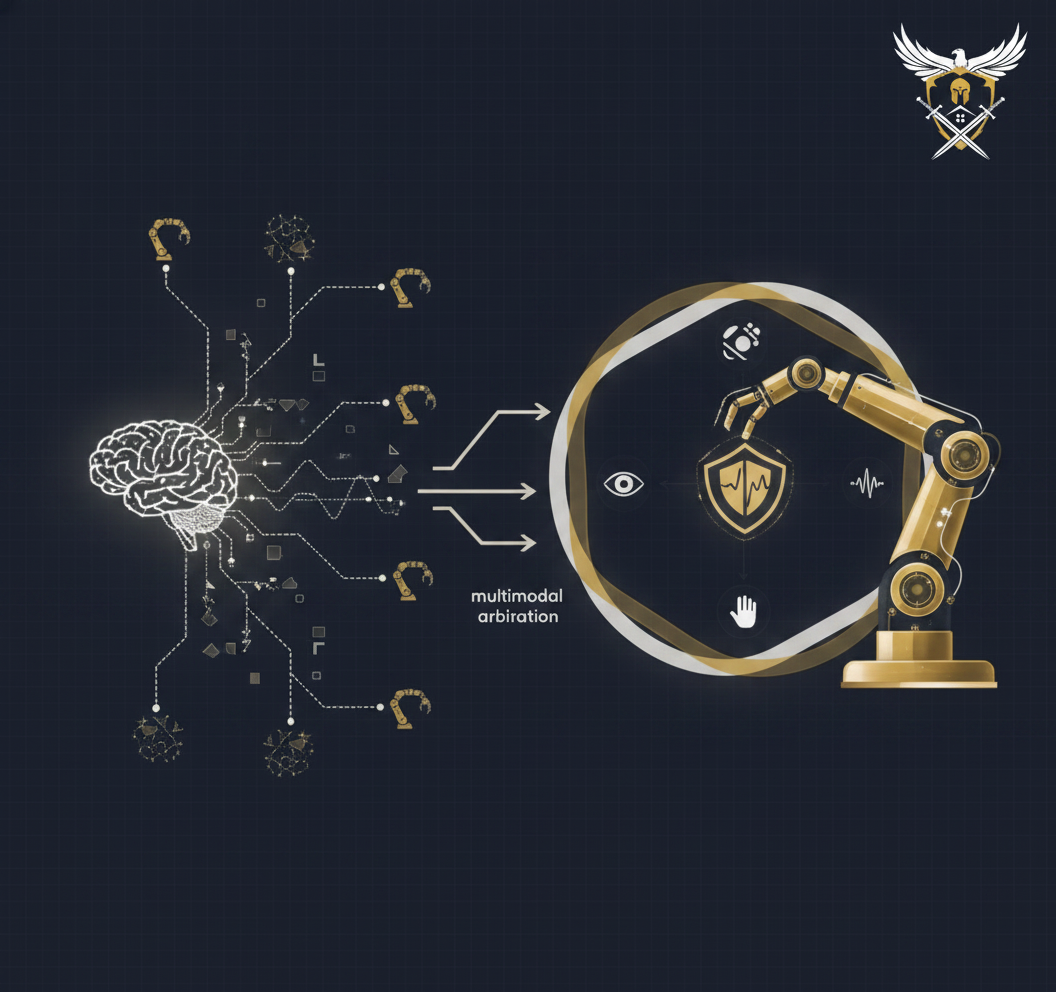
Mitigating Acoustic Cascades: Voice-Controlled Cobot Safety & Multimodal Arbitration
Architect voice-controlled cobots safely. Learn how to mitigate acoustic errors, prevent kinematic hazards, and design robust multimodal arbitration loops.
What happens when an 85 dB transient spike from a pneumatic exhaust transforms an operator's command to "jog slow" into an unconstrained, high-torque axis rotation?
In modern industrial automation, that single phoneme substitution is not a software glitch—it is an immediate, catastrophic crush hazard. As manufacturing facilities accelerate the deployment of voice-actuated human-robot collaboration (HRC) cells, robotics safety engineers face an unprecedented challenge: bridging non-deterministic Natural Language Processing (NLP) models with rigid, deterministic functional safety requirements.
Traditional functional safety assumes predictable operator inputs via pushbuttons, deadman switches, and light curtains. However, integrating Automatic Speech Recognition (ASR) introduces probabilistic risk into the primary control layer. When background plant chatter, mechanical resonance, and reverberation degrade the acoustic signal-to-noise ratio, Word Error Rates (WER) surge. Without rigorous acoustic error mitigation and arbitration logic, acoustic misclassifications propagate directly to motor drives.
The Illusion of High-Accuracy ASR on the Factory Floor
In our experience stress-testing collaborative robotic cells across varied acoustic environments, acoustic confidence scores are dangerously deceptive. What we have consistently seen is that an off-the-shelf ASR engine boasting a 96% benchmark accuracy rate in laboratory conditions degrades rapidly under real-world plant harmonics. A 4% failure rate in a continuous manufacturing shift translates to dozens of anomalous commands per day sent directly toward actuator motion controllers.
Most integration guides treat voice control merely as an accessibility interface or a software layer add-on. That perspective is fundamentally flawed.
Treating raw acoustic outputs as direct inputs to robotic motion execution without physical-state gating is structural negligence. Speech recognition models—including modern transformer architectures—do not understand physical mass, spatial constraints, or momentum. If your architecture executes kinematic trajectories based solely on an acoustic confidence score without secondary multimodal validation, you have built an uninsurable physical hazard into your workcell.
Architecting Multimodal Arbitration Loops
To maintain compliance with standards such as ISO/TS 15066, which governs collaborative robot operations and biomechanical threshold limits, safety engineers must implement a layered arbitration pipeline:
- Phoneme-to-Action Error Tree Analysis: Safety engineers must map critical command vectors against acoustic confusion matrices. High-risk verbs (e.g., "stop", "drop", "lock") that share phonemic proximity with hazardous inverse commands must be isolated and subjected to strict acoustic dissimilarity filters.
- Temporal & Gaze-State Correlation: Voice tokens must never execute in isolation. A secondary validation layer—such as operator line-of-sight tracking via depth sensors or spatial zone occupancy—must confirm that the operator is actively engaging the target cobot before the command bus unlocks.
- Tactile & Force-Gated Confirmation: For high-torque maneuvers, require a concurrent low-cognitive-load physical or gestural confirmation token to break the acoustic single point of failure.
- Dynamic Velocity Capping: Any voice-derived path planning command must automatically downscale joint velocity and torque thresholds until multimodal arbitration is verified across all concurrent safety channels.
Securing voice-controlled cobots requires an unapologetically defensive approach to automation architecture. You cannot afford to let probabilistic speech recognition dictate physical kinematics in shared human workspaces. Eliminate acoustic cascade risks, standardize your multimodal arbitration matrices, and establish ironclad cobot safety today.
👉 See what's inside: https://kema-ab0kdd7xd-knight-byrd.vercel.app/go/voice-controlled-cobot-safety/blog
KnightByrd Tech researches fast-moving digital trends and publishes practical, tested products and guides. About the publisher →