National Fraud Enforcement Mandates: How Tier-2 Regional Banks Must Adapt SAR Escalations Now
Prepare your Tier-2 regional bank for heightened federal fraud enforcement, updated SAR escalation triggers, and restructured evidentiary audit standards.
If your fraud intake and BSA/AML escalation pathways still rely on last year's enforcement assumptions, your institution is already carrying unquantified regulatory liability. Regional banks in the $10B to $100B asset band occupy a uniquely vulnerable position today: large enough to draw aggressive supervisory focus from federal task forces, yet rarely equipped with the sprawling manual review teams maintained by money-center giants.
With the centralization of federal anti-fraud inter-agency initiatives and revamped strike-force priorities, the margin for delayed or generic Suspicious Activity Report (SAR) filings has collapsed. Doing nothing—or simply waiting for your next scheduled OCC or FDIC examination cycle—guarantees an immediate audit finding under tightened civil liability frameworks.
The Shift in Evidentiary Intake
Historically, regional institutions could defend standard 30-day escalation cadences so long as investigative queues stayed within baseline parameters. That standard no longer holds. Under updated evidentiary intake expectations established across inter-agency working groups, supervisory bodies expect proactive cross-channel convergence—merging instant payment fraud telemetry, check-kiting signals, and wire anomalies into unified narrative files well before standard batch review windows close.
According to published FinCEN Guidance on SAR filing standards, the quality, precision, and timeliness of narrative documentation directly determine regulatory compliance efficacy. Regulators are no longer evaluating check-the-box submission counts; they are scrutinizing the tactical evidentiary bridge between transaction alerts and formal law enforcement escalations.
In our experience reviewing institutional compliance architectures across mid-tier lenders, the most critical breakdown consistently occurs at the friction point between fraud operations and the BSA unit. Disparate ticketing queues, misaligned loss thresholds, and delayed intake handoffs routinely allow high-risk syndicates to drain deposit accounts across multiple branches before a formal investigative narrative even opens.
The Defensive Filing Trap
Here is what traditional compliance consultants will not tell you: simply lowering transaction thresholds to flood FinCEN with defensive SARs is a tactical mistake that invites heightened scrutiny. Regulators know when an institution is dumping low-context alerts to artificially suppress audit exposure. When federal prosecutors and regulatory examiners review an institution's books, a mountain of boilerplate SAR filings containing incomplete evidentiary attachments signals broken internal governance, not rigorous oversight.
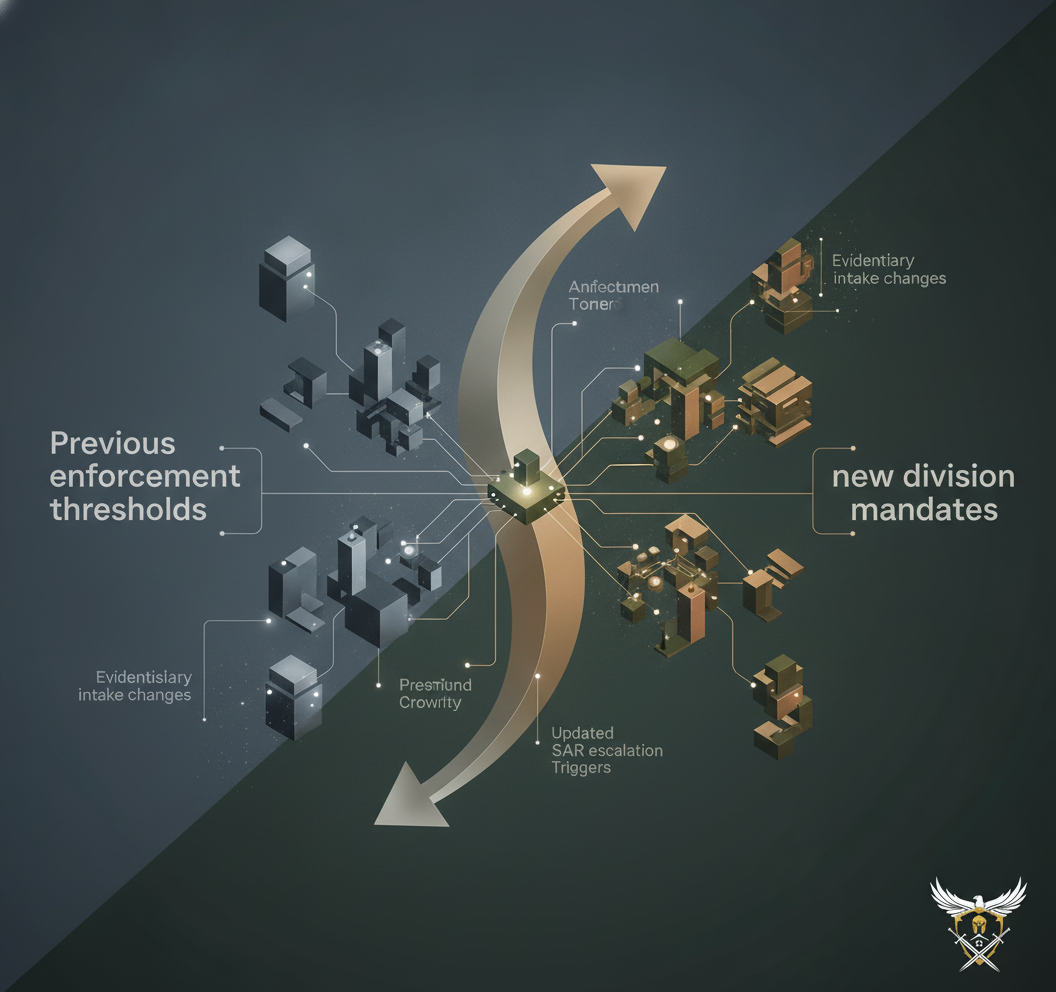
True exposure mitigation requires an objective comparative crosswalk: systematically comparing your prior threshold triggers against updated federal enforcement priorities. You must establish strict, immediate escalation rules for multi-jurisdictional synthetic identities, rapid account draining, and coordinated business email compromise (BEC) vectors.
Securing Your Compliance Posture Today
Regional bank risk officers must transition their fraud risk assessment and SAR escalation protocols immediately. Your program must prove verifiable linkage between front-line detection, real-time alert triage, and defensible narrative documentation.
Don't wait for a formal supervisory finding or an unexpected enforcement subpoena. Audit your intake workflows, realign your threshold escalations, and secure the tactical advantage needed to protect your institution today.
👉 See what's inside: https://kema-6y3wulmrr-knight-byrd.vercel.app/go/national-fraud-enforcement-division/blog
KnightByrd Tech researches fast-moving digital trends and publishes practical, tested products and guides. About the publisher →