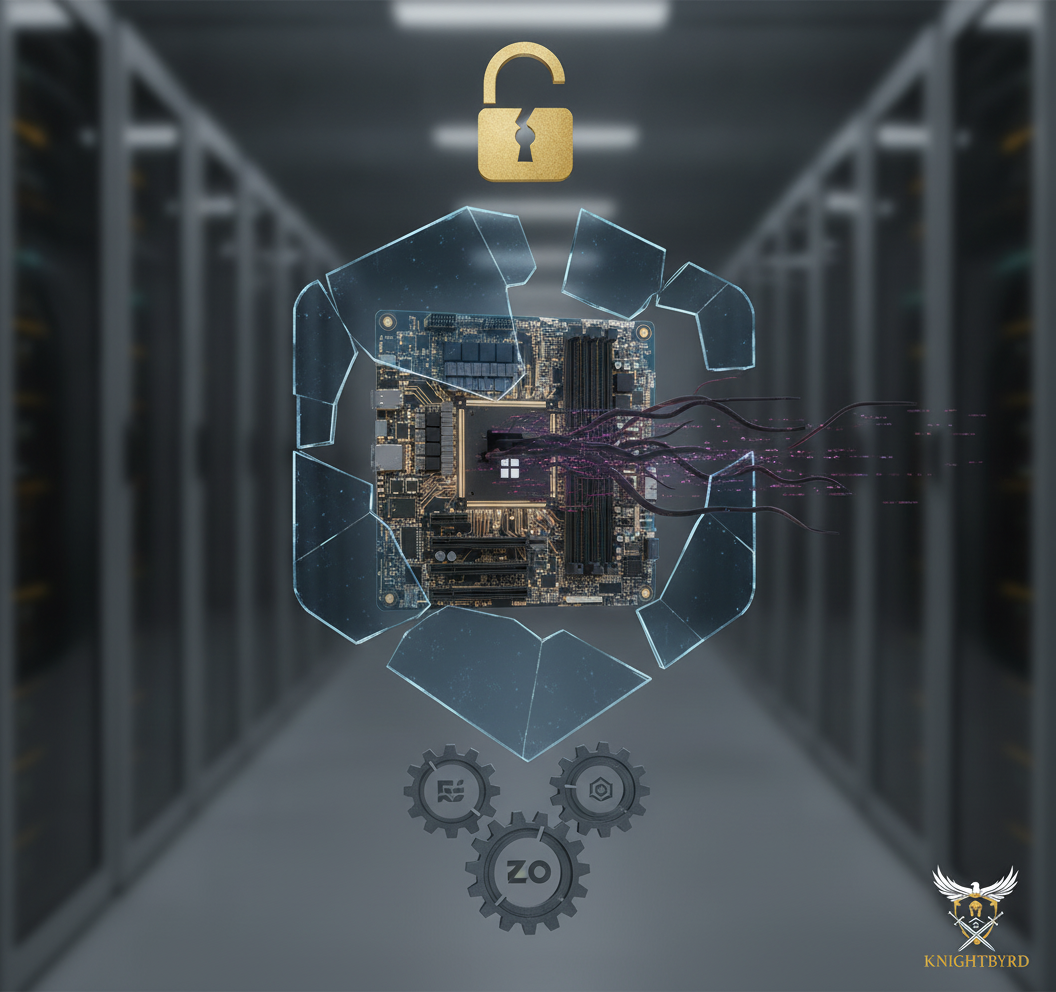
Mitigating x86 Hardware Backdoors: The Bare-Metal Isolation Strategy CISOs Need Right Now
Immediate, vendor-neutral x86 hardware backdoor containment and bare-metal isolation protocols for financial data center CISOs and infrastructure engineers.
If your cryptographic root of trust is compromised at the silicon layer, what is actually safeguarding your high-assurance workloads?
When undocumented SMM exploits, execution engine vulnerabilities, or architectural silicon backdoors emerge across enterprise x86 fleets, waiting 60 to 90 days for an upstream microcode patch from OEMs is not risk management. It is negligence. In financial data centers where transaction integrity and hardware security modules (HSMs) are non-negotiable, unmitigated silicon vulnerabilities bypass every traditional defense-in-depth layer—including your hypervisor, kernel security policies, and zero-trust network microsegmentation.
The immediate threat is not hypothetical. Zero-day microarchitectural flaws and covert management engine vectors increasingly bypass OS-level attestation. When an unauthenticated hardware-level compromise hits, your bare-metal servers and confidential computing enclaves are exposed to silent data exfiltration and cryptographic key extraction before public CVE advisories even finalize mitigation guidance.
In our experience auditing high-assurance infrastructure, enterprise response protocols break down immediately at Ring -2 and Ring -3. Infrastructure teams scramble to determine which CPU steppings are exposed, while security operations teams find themselves entirely reliant on vendor press releases. What we have consistently seen across tier-1 infrastructure is a fatal gap: teams possess robust playbooks for software-layer containment, but zero deterministic protocols for bare-metal silicon isolation.
Let’s address what hardware vendors and traditional analyst reports will not tell you: relying on vendor-supplied microcode updates as your primary containment strategy is an operational failure mode.
Silicon vendors balance security patches against yield stability, thermal throttling, and multi-tenant performance overheads. Their timeline is driven by release engineering and liability control; your timeline is dictated by active adversarial exploitation. If you do not have independent, vendor-neutral protocols to enforce memory bus isolation, disable compromised prefetchers, sever unauthenticated Baseboard Management Controller (BMC) pathways, and quarantine cryptographic execution domains, you are operating entirely on borrowed time.
Establishing platform integrity requires aligning your bare-metal operational posture with strict structural baselines, such as the NIST SP 800-193 Platform Firmware Resiliency Guidelines. However, while federal standards establish the theoretical requirement for firmware protection and recovery, they do not hand you the deterministic command-line runbooks needed to isolate active hardware compromises in real time.
A resilient bare-metal defense requires three immediate structural capabilities:
- Silicon-Level Telemetry & Microcode Auditing: Deterministic verification of CPU stepping states, active microcode revisions, and Model-Specific Register (MSR) configurations without relying on high-level OS attestation.
- Enclave and Speculative Execution Containment: Practical operational playbooks to quarantine affected cryptographic enclaves, selectively disable vulnerable branch prediction mechanisms, and segment direct memory access (DMA) channels.
- Objective Triage and Hardware Retirement Matrices: Clear operational criteria that dictate exactly when an x86 node can be safely mitigated in-place versus when high-assurance workloads must be dynamically drained for physical decommission.
Every day an unmitigated silicon vulnerability persists on your compute fabric, your enclave guarantees are void. Don’t wait for an adversary or a delayed public advisory to breach your high-assurance data center—establish an aggressive bare-metal containment and hardware isolation posture today.
👉 See what's inside: https://kema.knightbyrd.com/go/x86-hardware-backdoor-containment/blog
KnightByrd Tech researches fast-moving digital trends and publishes practical, tested products and guides. About the publisher →